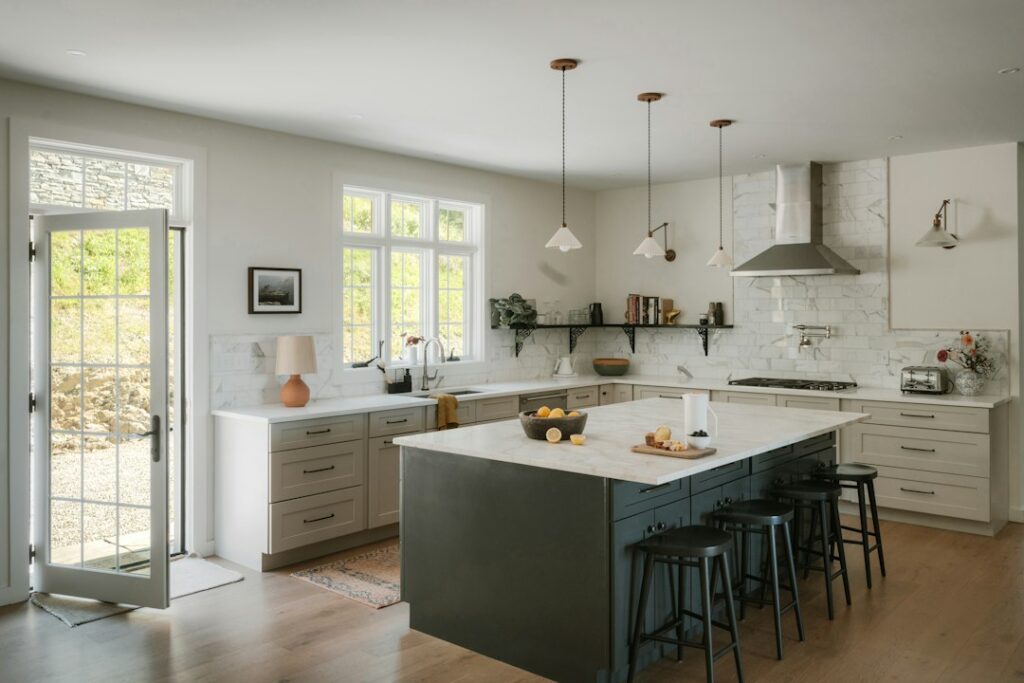

Cabinet refacing replaces the doors and drawer fronts, then covers exposed frames and cabinet ends with a coordinated veneer or manufactured surface. The existing boxes remain in place, so the work depends on their condition and on accurate measurements. Refacing differs from refinishing, which generally renews the existing doors with sanding and new coatings. Replacement removes the boxes as well. A sturdy oak cabinet with faded fronts may be a good refacing candidate, while particleboard swollen beside a sink needs careful inspection. Ask whether damaged sections can be repaired before approving a finish plan.
Measure the room before choosing a style. Record appliance door swings, walkway widths, landing space beside the cooktop, and the distance between the refrigerator, sink, and cooking area. The traditional work triangle can help describe these relationships, although kitchens with several work zones may not fit that pattern neatly. A peninsula can make seating attractive while narrowing the main route, and a new pullout will not solve a refrigerator door collision. In a Hamilton home where two people prepare meals together, reversing a door swing or moving one cabinet may improve use more than decorative molding.
Hardware deserves the same attention as the visible finish. Hinges determine how doors open and close, while drawer slides affect load capacity, extension, and movement. Soft-close mechanisms slow the final part of a door or drawer’s travel, but they do not correct a cabinet that is twisted or poorly mounted. A cookware drawer used several times each evening needs properly fitted slides suited to its load. Handle locations should be tested before drilling. A cardboard template lets a homeowner check reach, clearance, and alignment while standing at the counter, rather than discovering an awkward placement after installation.
Preparation determines much of the finished appearance. Doors and frames should be cleaned of grease, inspected for loose edges, and lightly abraded when the selected system calls for it. Primer can help the finish bond and provide a consistent base, but it will not conceal deep dents, swollen board, or active water damage. Counters, floors, appliances, and nearby walls need protection before spraying or brushing begins. Painted samples belong in the actual kitchen, where daylight, under-cabinet lighting, and countertop colors can change how the same shade appears. A sample viewed only in a showroom can lead to an avoidable color mismatch.
The cabinet interiors should be part of the conversation, even though standard refacing focuses on the outside. Worn shelves, damaged drawer bottoms, and poorly placed organizers can continue to waste space after new fronts are installed. Adjustable shelves may accommodate tall containers more effectively than fixed ones, while a shallow tray near the range can keep oils within reach without crowding the work surface. A pullout waste bin may improve access in a tight base cabinet. Ask which interior changes are included, since shelves and organizers may be separate from the refacing scope. This is where kitchen renovation becomes a functional update rather than a purely visual change.
Before work begins, request a clear assessment of the boxes, exposed ends, door alignment, hardware, and possible repairs. Review the written scope so hidden damage, interior accessories, and finish samples are not left to assumption. During installation, a careful crew protects the room, labels or organizes removed pieces, and checks mounting points before final adjustments. At the walkthrough, open every door, test each drawer, inspect the gaps, tighten handles, and look for clean transitions around appliances and walls. Homeowners comparing approaches can consult practical cabinet refacing guidance while deciding whether their priorities are structure, storage, movement, or appearance.